
Hall Boys: Student Life at Nazareth Hall

On July 18, 1743, John and Christina Franke and John Heyne, members of the Moravain Church settlement in Nazareth, Pennsylvannia founded a school for boys in the Gray Cottage. The school, was the foreruner to Nazareth Hall. For 180 years, the school was in operation, with the exception of a period of six years.
Nazareth Hall was at the forefront of progressive education in America. It was one of the first schools to teach Geography in 1785, and in the 1850s it introduced courses in Bookkeeping, Surveying, and Industrial Drawing. Nazareth Hall closed on June 12, 1929.
A Moravian Education: Founding Nazareth Hall
When the Moravian settlements of Nazareth and Bethlehem opperated under a General Economy (1741 to 1762), children in the community were provide an education. Moravian missionaries, who traveled in service to the church, did not always have the personal resources to provide for the families they left behind. The church resolved to support the missionaries by providing free or affordable education for their children. In its earliest years as a boarding school, Nazareth Hall instructors were primarily trained mechanics, however some instructors had received a classical education in Europe.
The school closed in 1779 after a period of declining enrollment. In 1764 , 106 students were enrolled in the school by 1779, there were only 11 students. A group of alumni --many of whom became leaders in the Moravian Church--gathered to reorganize and reopen Nazareth Hall in 1785.
Nazareth Hall's reorganization included the creation of a set of regulations outlining the school's services and expectations of students and their parents. A significant part of the reorganization was the admission of non-Moravian students, providing their parents "approve of their manner of instructing and educating youth, and are desirous to have them brought up in the nurture and admonition of the Lord, preserved from seduction and the prevailing vices of the age, and at the same time to become useful members of society." The rest of the regulations can be viewed on page 25 of "A history of Nazareth Hall, from 1755 to 1855: and of the reunions of its former pupils, in 1854 and 1855." by Rev. Levin T. Reichel.
Preserving the Culture and History of Nazareth Hall
A chance meeting between Nazareth Hall alumni, John Baker (class of 1826) and Daniel D. Gassner (class of 1825), put into motion an interest in preserving alumni recollections of the school. Baker and Gassner organized the first Alumni Reunion at Nazareth Hall in 1855. The success of the reunion prompted the formation of the Nazareth Hall Alumni Association, which flourished until the 1960s. At the Association's request, alumni contributed letters containing their memories of Nazareth Hall. The Alumni Association compiled these letters into published histories of Nazareth Hall, and in issues of "The Hall Boy" periodical. Together, these sources provide an important glimpse into the history and daily life of Nazareth Hall.

A history of Nazareth Hall, from 1755 to 1855: and of the reunions of its former pupils, in 1854 and 1855.
Paper
Collection of the Moravian Historical Society
Digitized version available at Hathi Trust Digital Library

Historical sketch of Nazareth Hall from 1755 to 1869: with an account of the reunions of former pupils and of the inauguration of a monument at Nazareth on the 11th of June, 1868, erected in memory of alumni who fell in the late rebellion.
Paper
Collection of the Moravian Historical Society
Digitized version available at Hathi Trust Digital Library

Nazareth Hall: an historical sketch and roster of principals, teachers and pupils
Paper
Collection of the Moravian Historical Society
Digitized version available at Hathi Trust Digital Library
Curriculum and Schedule at Nazareth Hall
The early curriculum of Nazareth Hall was modeled after a classical European education. The curriculum included Latin, Geometry, Music, and languages such as German and French.
In the 1860 Catalogue of Nazareth Hall, the list of regular courses included: Reading, Writing, Arithmetic, Orthography, History, Geography, Composition, Elocution, English Grammar, Logic, Algebra, Geometry, Surveying, Astronomy, Geology, Bookkeeping, Natural Philosophy, Chemistry, Physiology, the Constitution of the United States, German, and Instruction in Vocal Music. The courses available for an extra charge included: Greek, Latin, Spanish, French, Drawing, Painting, and instruction on various instruments such as Piano, Melodeon, Organ, Violin, Flute, and more. Over the years, additional courses addressed new needs in business and education, including Stenography, Typewriting, and Business Arithmetic.
As a boarding school, Nazareth Hall provided a daily schedule structured to ensure the boys were supervised and occupied with productive activities. Per the the school's regulations, "A particular attention will be paid that the scholar are constantly under inspection, not only in school hours, but also at all other times."
The yearly schedule also reflected careful attention to the young scholars' needs and to community celebrations. In 1860, the list of special holidays included February 22nd, Good Friday and Easter Monday, excursions to the lake in May, the anniversary of the founding of the school on October 3rd, excursions to the mountains in November, and Christmas Recess. Summer vacations allowed the students to visit home, and, for those unable to undertake travel home, the school allowed them to remain under the care of teachers.
In 1798:
7:30 - 8:30 AM - German and English reading, grammar, history
8:30 - 9:00 AM - Children's meeting, devotional exercises
9:00 - 10:00 AM - Latin, geography, natural history
10:00 - 11:00 AM - Arithmetic, geometry, bookkeeping
2:00 - 3:00 PM - Writing, drawing
3:00 - 4:00 PM - French

Wooden bed from Nazareth Hall
1780-1820
wood
Collection of the Moravian Historical Society. Gift of Benjamin and Carol Walbert, 2005
This bed from Nazareth Hall is typical of a German-style bedstead, which uses slats for support. According to a late 1700s diary entry, the bed would have been filled with a layer of straw bedding, followed by feather bedding, sheets, and blankets. Students were required to provide their own linen and bedding at Nazareth Hall.
In 1929:
7:15 AM - Breakfrast
7:50 AM - Study Hour
Called "Order of the Day," this schedule was followed every day except Wednesdays and Saturdays, which were treated as half-holidays. With classes each Saturday morning, a weekend leave of absence only lasted from Saturday noon to Sunday evening. All cadets who were away on weekend leave were required to return before taps on Sunday evening.
Principals of Nazareth Hall
Although most histories of Nazareth Hall begin with the reorgnization in 1785, the following list includes all of the principals who served the school. In later years, the Nazareth Hall campus provided offices and homes for the principal, enabling them to be present in daily activities, such as leading Devotions and morning/evening prayers in the chapel. The wives of principals played an important role in the management of Nazareth Hall and oversaw the general household. Many of them were referred to as "Mother" by the students.

Portrait of Arthur D. Thaeler
Principals of Nazareth Hall
After the 1785 Reorganization
Charles G. Reichel (Principal from 1785-1802)
Jacob Van Vleck (Principal from 1802-1809)
Charles F. Seidel (Principal from 1809-1817)
John C. Beckler (Principal from 1817-1822)
William Henry Van Vleck (Principal from 1822-1829)
John G. Herman (Principal from 1829-1837)
Charles A. Van Vleck (Principal from 1837-1839)
Charles F. Kluge (Principal from 1839-1844)
John C. Jacobson (Principal from 1844-1849)
Levin T. Reichel (Principal from 1849-1853)
Edward Rondthaler (Principal from 1853-1854)
Edward H. Reichel (Principal from 1854-1866)
Robert de Schweinitz (Principal from 1866-1867)
Eugene M. Leibert (Principal from 1867-1892)
Charles C. Lanius (Principal from 1892-1897)
Samuel J. Blum (Principal from 1897-1916)
F. E. Grunert (Principal from 1916-1918)
Arthur D. Thaeler (Principal from 1918-1929)

Portrait of Ruth Caroline Thaeler, née Schropp
Academic Accessibility and Excellence
Many students received scholarships to attend Nazareth Hall. In addition to a scholarship system for the sons of Moravian missionaries, Nazareth Hall also boasted privately-funded scholarships from community leaders. One such sponsor was George Boldt, President of the Waldorf–Astoria Hotel Company, who according to his correspondence with Nazareth Hall funded the education of several boys in Nazareth Hall.
Nazareth Hall emphasized that all students should strive for academic success. Annual awards and prizes recognized students with levels of high achievement in their yearly scores.
According to the 1925 Catalog, the following prizes could be awarded at the end of the academic year:
Senior Prizes
- Francis Weiss Medal, for best record in the Study of History, including American History and Civil Government.
- John T. Gram Medal, for an Upper Senior Cadet who has done the best work in Science.
- Ernestine Huebner Kistler Medal, for the highest grade in Plane and Solid Geometry.
- Phyllis Ruth Senie Medal, for the best Latin scholarship.
Junior Prizes
- William H. Milchsack Prize, for the best work in Mathematics.
- Mr. Theodore Schall Prize, for the best work in History.
- Mrs. A. G. Connolly Prize, for highest in scholarship and deportment.
Lower School Prize
- William V. Knauss Prize, for the highest percentage in Arithmetic throughout the year.
- Waterman Fountain Pen to the student who has shown the greatest improvement in penmanship throughout the year.
- Alumni Medal by the General Alumni Association to the student who maintained the highest average over ninety-five percent.

William H. Milchsack Mathematics Prize

Francis Weiss American History Prize

Students of Nazareth Hall
Military Discipline and Uniform
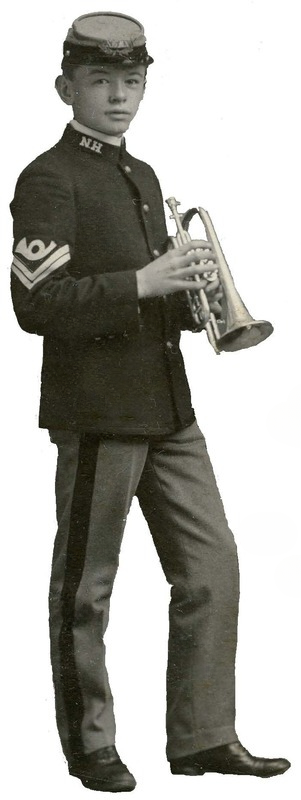
Nazareth Hall adopted military drills and discipline in 1862, during the Civil War. At that time, the school did not advertise itself as a military preparatory institution. The school's published literature emphasized that Nazareth Hall was founded as an "integral part of the community...designed to bring about a broader understanding and larger degree of of good will among men."
Publications from Nazareth Hall describe the adoption of military discipline "not as a preparation for war, but against war." Drills and discipline could be applied to all aspects of education, including following instructions, punctuality, personal hygiene, and team work. The military-style uniform reinforced this vision. The uniform, consisting of matching gray wool jacket and pants, unified the student body and distinguished Nazareth Hall boys from the public school children in the surrounding area.
A Service Uniform, for everyday use
A Field Uniform, including three khaki chambray shirts
A Military Overcoat, of dark blue cloth and appropriate for civilian use as well
A list of personal articles required by each boy was also included in the school catalogs. This list included such items as underwear for both warm and cold weather, handkerchiefs, black shoes (never brown), a small rug for the dormitory, and one "comfort."
Learn more by exploring the Nazareth Hall Collection of the Moravian Historical Society.
This collection includes:
- The Hall Boy (Periodical)
- Student Classwork from Nazareth Hall
- Catalogues of Nazareth Hall
- Correspondence of Nazareth Hall Principals
- Nazareth Hall Objects
- Financial papers from Nazareth Hall
- List of Students of Nazareth Hall from 1785 to 1929
